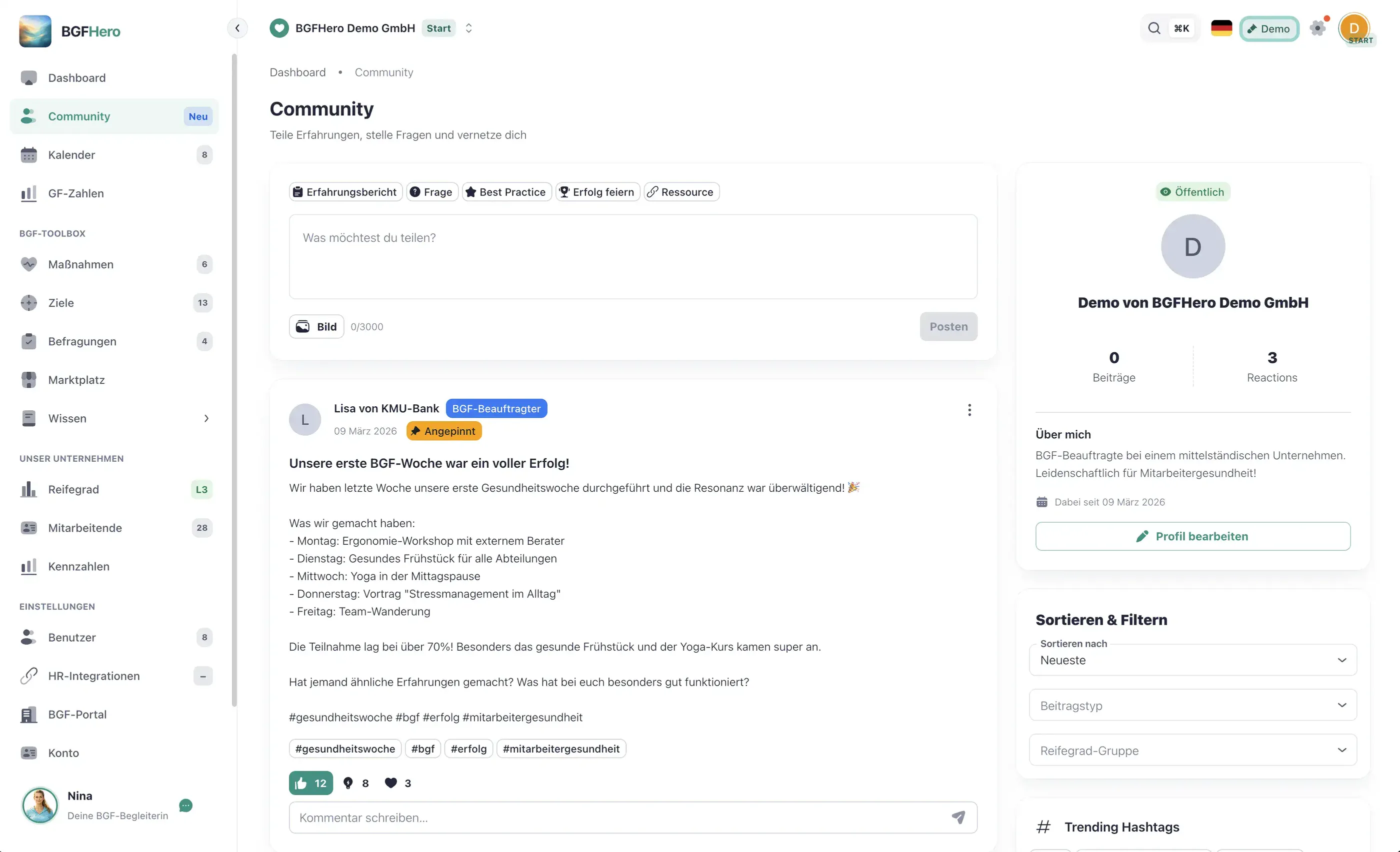
Peer Learning in BGM: Learning from Other BGM Teams Instead of Reinventing Everything Yourself
Why BGM lone fighters especially benefit from community
In most companies, BGM coordinators work in a special role: you're the point of contact for health topics, the coordinator between leadership and staff, the project manager for measures – and often as a single person or small team without a dedicated department behind you. Colleagues in controlling or marketing can talk about internal learnings; in BGM, by contrast, knowledge often stays locked within the company.
This has a direct consequence: anyone without peers repeats mistakes that are already well known elsewhere. Anyone who doesn't ask spends weeks developing concepts that another company with 200 employees has already tested and adapted. That's not a weakness – it's simply an information problem. And information problems can be solved.
Peer learning in BGM doesn't mean blindly adopting recommendations. It means asking specific questions about real situations and getting answers from people who know the same context: similar company sizes, similar industries, similar challenges around shift work, remote work, or getting managers on board.
Benefiting from others' experience in 15 minutes a week
Most BGM coordinators don't have time for hours-long networking events. But peer learning also works in small doses – when the right questions reach the right group.
The key lies in specificity. Instead of "Does anyone have experience with movement programs?" the question "Has anyone introduced lunch walks in shift operations – how did you coordinate that with shift schedules?" produces usable answers within hours. Specific questions about specific measures generate specific feedback.
A realistic weekly pattern looks like this: Monday, spend two minutes skimming community activity and checking whether anyone has posted a question relevant to you too. Wednesday, formulate and post your own question about your current measure. Friday, read the responses you've received and comment on one of them or add your own experience. That's 15 minutes – and it replaces hours of independent research.
The filter function is crucial here: a community that can be filtered by industry and company size delivers peers with comparable context. What works in a 5,000-person corporation only translates to a mid-sized manufacturing company with 80 employees to a limited degree.
How peer-learning insights flow directly into your own BGM
A good exchange of experience doesn't end with reading. It ends with you transferring a specific idea from the community into your own action plan – with the necessary distance and the knowledge of what works in your company and what doesn't.
The easiest way to do this is with a clear structure: when you read something in the community that sounds relevant to you, immediately jot down three things – what the other person did, what of that fits your context, and what you'd need to adapt. These three points are the seed of a new measure.
The effect multiplies when you share as well. A community lives on giving and taking. Anyone who contributes their own experiences – even when a measure didn't work – raises the quality of the knowledge pool for everyone. And anyone who honestly reports that the back-care course was barely booked in the first quarter, and why, helps another BGM coordinator avoid the same mistake.
So setzt du es um
- 1Create a profile in the EasyBGM Community: Create your profile in the EasyBGM Community. Enter your industry, company size, and your BGM focus areas — this is the basis for other members to assess whether their experience is relevant to you, and vice versa.
- 2Filter by industry and company size: Use the filter function to narrow down posts and members by industry and company size. Experience from a comparable context is worth more than ten general recommendations.
- 3Ask a first concrete question: Formulate a specific question about a current measure or challenge in your BGM — for example, about participation in a new offering, communication with managers, or implementation in shift operations. Concrete questions produce usable answers.
- 4Try a best practice from another company: Choose a measure from the community that fits your context and test it in an adapted form at your company. Note what you changed and why — this makes the experience evaluable for you and others.
- 5Share your own experience back with the community: Report back to the community how your test went — even if the result was mixed. Honest feedback about what didn't work is often more valuable to others than pure success stories.
Was du brauchst
- Aufwand
- under 30 min
- Kosten
- Free
- Dauer
- laufend
- Setup
- 10 Min.
- ✓ Reduces planning time because you don't start from zero — others have already worked through similar questions.
- ✓ Avoids typical beginner mistakes that are already known and documented in comparable companies.
- ✓ Delivers context-accurate input through industry and size filters instead of generic recommendations.
- ✓ Strengthens your position as BGM officer, because you can justify decisions with external practical evidence.
Für dein Unternehmen übernehmen
Ein Klick — und die Maßnahme liegt vorbereitet in deinem Plan. Geführt Schritt für Schritt, kein langes Setup.
ÜbernehmenZahlt ein auf
Handlungsfeld
Passender Anlass
Passende Best Practices
Nicht sicher, wo ihr anfangen sollt? Selbstcheck →