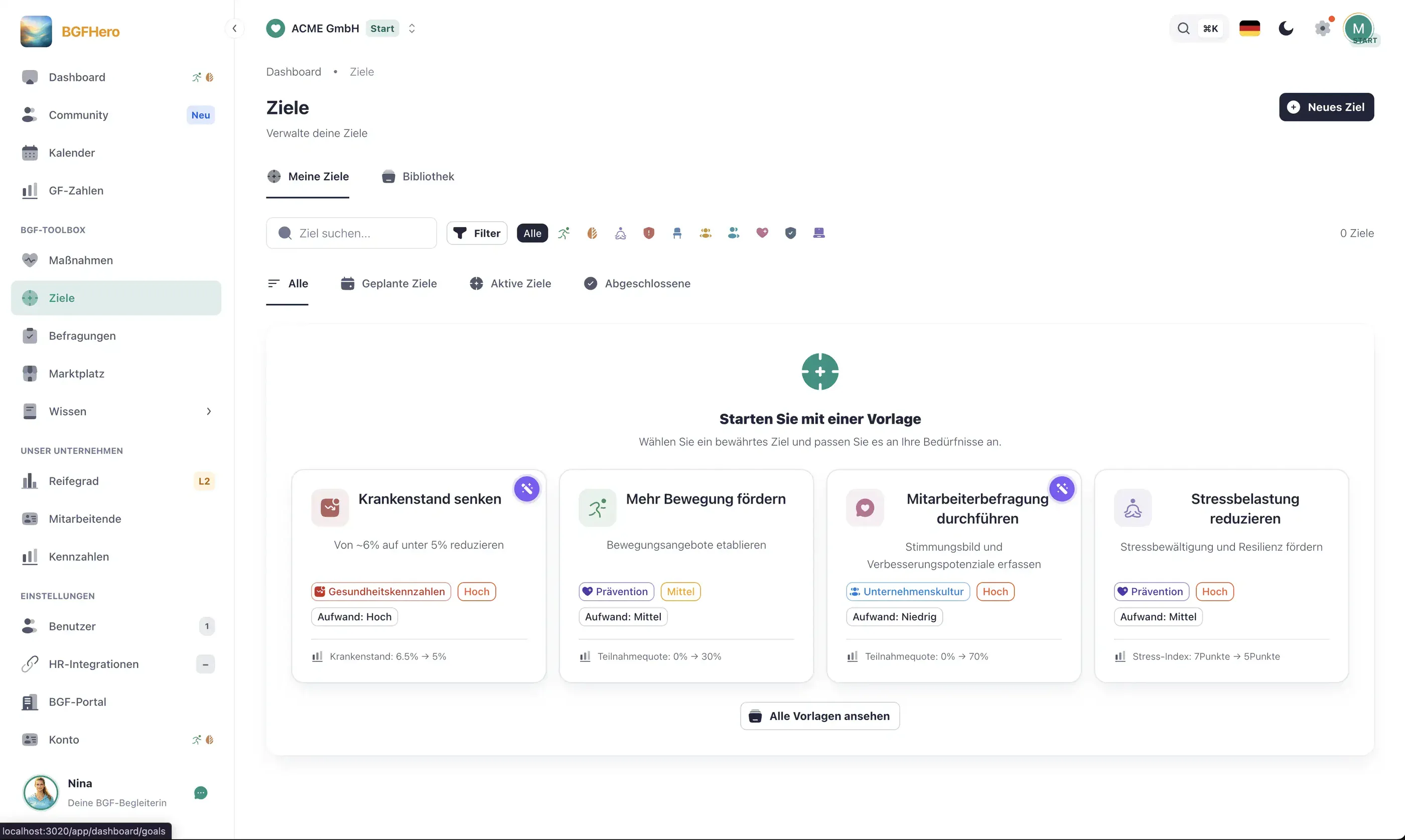
Formulating and Automatically Tracking SMART BGM Goals
Why BGM goals without tracking remain ineffective
Many BGM programs fail not from lack of engagement, but from lack of measurement. If you can't prove at year-end whether sick leave has dropped or the participation rate has risen, BGM quickly loses priority with leadership — and with it, its budget.
The classic pattern: measures are planned and implemented, progress is tracked sporadically in Excel, and shortly before the leadership check-in, you cobble together a colorful chart from three different sources. That not only costs time — it also produces errors and leaves the actual impact question unanswered. "We offered 12 back courses" is not a statement about impact. "Musculoskeletal sick leave dropped by 0.4 percentage points over 12 months" is.
The decisive step, therefore, isn't more measures, but first a clear goal — and then a system that makes progress continuously visible without anyone having to manually compile data for it.
What SMART goals look like in concrete BGM terms
SMART goals (Specific, Measurable, Attractive/Accepted, Realistic, Time-bound) aren't a theoretical construct in BGM — they work as soon as you apply them consistently to your own metrics.
A bad goal: "We want to reduce sick leave."
A good goal: "We reduce overall sick leave from the current 6.2% to below 5.5% by December 31, 2026, measured against monthly HR data from the payroll system."
More examples from practice: - **Movement:** "Participation in workplace movement offerings rises from 18% to 30% of the workforce by Q3 2026." - **Stress reduction:** "The share of employees with high perceived stress (scale ≥ 7/10 in the quarterly pulse check) drops from 34% to below 20% by the end of 2026." - **Managers:** "80% of team leads have completed the BGM basic training (2 hrs) by March 2026."
Important: translate these goals into leadership's language. A 1% reduction in sick leave means, for 100 employees and an average daily cost of €250, roughly €62,500 less in productivity loss per year — plus saved substitute-staffing costs. That figure belongs in every leadership presentation.
How automatic tracking practically writes the leadership report for you
Once goals are set up as KPIs, a good BGM system handles progress measurement automatically. In EasyBGM, you link each goal to a data source — whether that's sick-leave data from your HR system, participation figures from booked offerings, or survey results from the pulse check. The dashboard updates with every data sync.
Progress bars and trend arrows show at a glance which goals are on track and where action is needed. That not only motivates the BGM team — it also gives you a solid basis for the next leadership conversation. Instead of "I think we're on a good path," you say: "Goal 2 is at 73% — we still need a targeted measure for production in Q3."
The leadership report then practically writes itself: current goal values, trend development, next planned measures. What used to take 3 hours of data gathering now takes 20 minutes for the narrative.
So setzt du es um
- 1Gather current baseline figures: Pull the current absenteeism rate, participation rates, and existing survey results from your HR system and payroll. These figures become your baseline. No baseline, no SMART goal.
- 2Create SMART goals in EasyBGM: Create your BGM priorities under "Goals" in EasyBGM. Enter the current actual value, the target value, and the target date for each goal. Phrase the goal title so it works directly as an executive reporting slide.
- 3Link data sources: Connect each goal to its data source: absenteeism data comes from the HR import, participation rates are counted automatically from booked offerings, stress levels come from the pulse-check module. EasyBGM then updates the values automatically.
- 4Unlock the dashboard view for the team: Share the goal dashboard with your BGM team and the relevant managers. Visibility creates accountability — when everyone sees where things stand, motivation to actually implement measures increases.
- 5Schedule a quarterly review and export the executive report: Schedule fixed quarterly reviews (30 min.) where you evaluate progress and adjust measures if needed. Use the EasyBGM export for the executive report — goal status, trend, and next steps in one document.
Was du brauchst
- Aufwand
- under 30 min
- Kosten
- Free
- Dauer
- 12 Monate
- Setup
- 45 Min.
- ✓ Absenteeism and other KPIs always in view, up to date — without manual spreadsheet upkeep
- ✓ Executive reporting in 20 minutes instead of 3 hours: figures come automatically from the system
- ✓ Early warning signals: goals going off track are visible immediately — before it's too late
- ✓ BGM becomes investable: whoever knows the euro value of a 1% reduction in absenteeism gets the budget
Für dein Unternehmen übernehmen
Ein Klick — und die Maßnahme liegt vorbereitet in deinem Plan. Geführt Schritt für Schritt, kein langes Setup.
ÜbernehmenZahlt ein auf
Handlungsfeld
Passender Anlass
Passende Best Practices
Nicht sicher, wo ihr anfangen sollt? Selbstcheck →