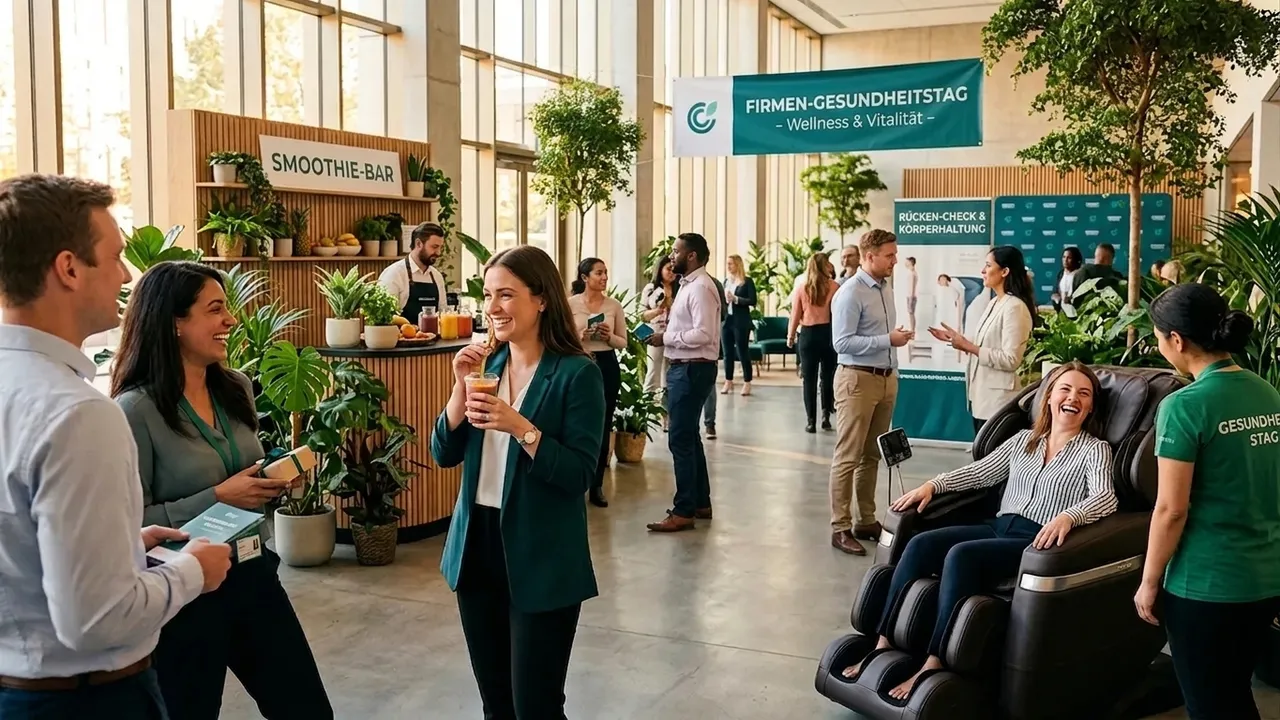
Setting aside half a day for health once a year sounds like a lot – and is in fact an effective investment in the workforce. Not because of the individual activities on that day, but because of the signal it sends.
What does an action day trigger that no newsletter can?
A health day creates experiences that employees talk about afterward. The blood pressure check that unexpectedly revealed high readings and made someone more attentive ever since. The back screening that showed the chair was set up wrong. The shoulder massage during lunch break. These moments aren't wellness cosmetics – they're genuine points of contact with one's own body, something that rarely happens in everyday work life.
What makes a health day successful?
The program needs a mix of active and informative, of mandatory and voluntary elements. Anyone forced to sit through lectures every three hours won't come back next year. Anyone who gets to try something themselves – an exercise, a check, a new offering – talks about it. The closing ritual, whether a shared lunch or a small prize for the most engaged team, determines whether the day is remembered as an event or as an obligation to get through. A good complement is the best practice The Health Day That Actually Works. In Germany, statutory health insurers can fund events like this as a project under Section 20b SGB V; there is no entitlement to it. How insurer funding differs from the tax allowance is explained in the guide Insurer funding and the tax allowance.
How to put it in place
- 1Set the 3 to 4 stations (e.g. back check, smoothie bar, stress test, movement course) and name one responsible person per station.
- 2Reserve a suitable room or outdoor area for half a day and get the material for each station (mats, blender and fruit, questionnaires, course elements).
- 3Draw up a rough schedule with rotation windows so that the teams are spread evenly across the stations.
- 4Send the invitation with date, time, place and a short description of the stations.
- 5Open a simple sign-up or time-slot selection so that you can estimate the load at the stations.
- 6Ask people to bring comfortable clothing and remind them of the date one to two days beforehand.
- 7Set up the stations in good time and brief the responsible people.
- 8Welcome everyone briefly and explain the schedule and the rotation between stations.
- 9Keep an eye on the flow, balance out queues and make sure the smoothie bar is restocked.
- 10Collect feedback in a short survey on which station went down best and what was missing.
- 11Record how many people took part and how much effort each station took.
- 12Use the feedback to decide which stations stay for a repeat and which you replace.
What you need
- Effort
- half a day
- Cost
- under €100
- Duration
- 1 day
- Setup
- 480 min
- ✓ High visibility
- ✓ Experience character
- ✓ Great photo material
Adopt it for your company
One click — and the measure sits ready in your plan. Guided step by step, no lengthy setup.
ÜbernehmenZahlt ein auf
Measure the impact with
Handlungsfeld
Passender Anlass
Passende Best Practices
Nicht sicher, wo ihr anfangen sollt? Selbstcheck →