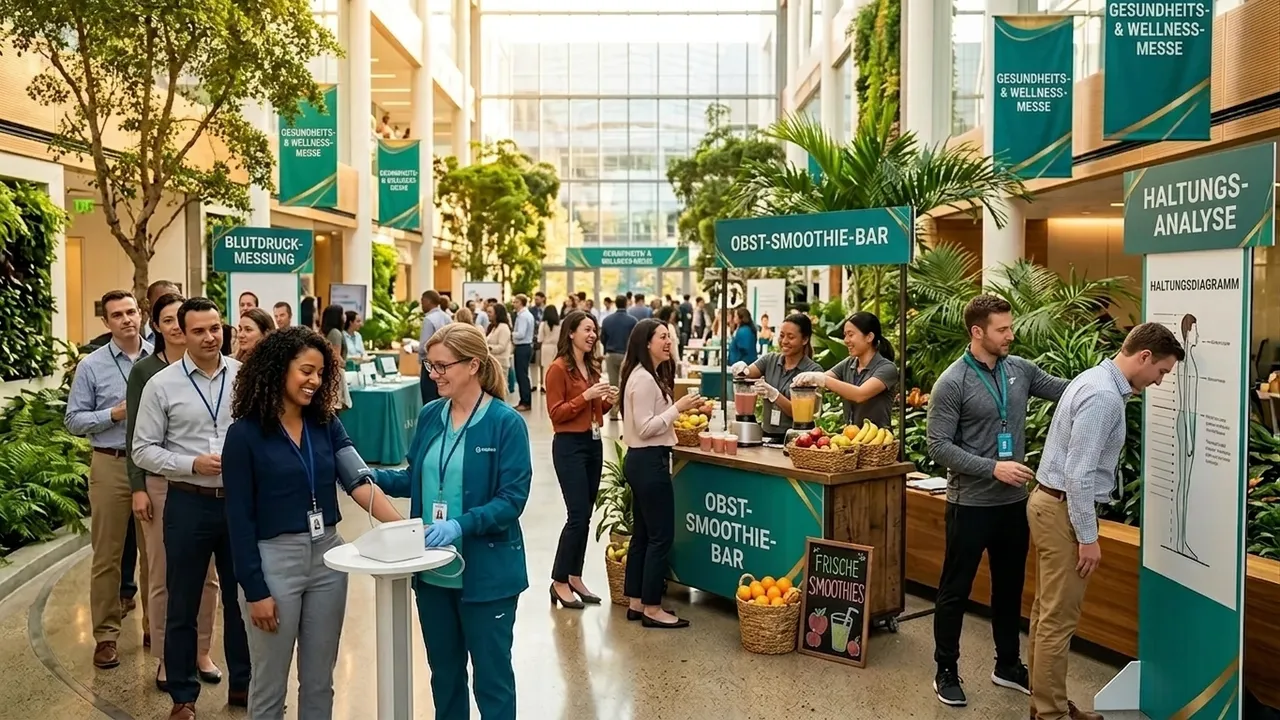
The Health Day That Actually Works
The most visible WHP event of the year – in the right dose: A focused health day with preventive offers is more effective than an overloaded program.
Why does an overloaded program get in its own way?
A jam-packed day with twelve stations looks impressive on the poster but is overwhelming in reality. Attention drops off after just a few hours, and at each station, queues or yawning emptiness form. Less is more here: Three to four really good offers that you can experience at your own pace will stick with you.
What actually works on a health day?
Concrete, personally tangible formats have proven effective – a measurement with immediate results, a quick check by professionals, a low-threshold participatory offer, an open conversation. What matters is that people go home with something tangible: an insight, a value, a first step.
What framework enhances the impact?
Around World Health Day in April, attention – both internally and externally – is at its highest. And for smaller companies: A self-organized mini health day with two good offers is a fully valid starting point. The occasion makes the topic impossible to miss once a year; the measures behind it carry it through the rest of the year. In Germany, statutory health insurance funds can support such actions as a project under § 20b SGB V; there is no entitlement to this. The guide Insurer funding and the tax allowance explains the difference between health insurance funding and tax exemption.
How to put it in place
- 1Set the date, place and budget and get them approved internally
- 2Book external providers: screenings (blood pressure, eye test), movement stations, nutrition and ergonomics advice, relaxation offers
- 3Time the programme: a station plan with time slots, so that no queue forms at any stand
- 4Clarify responsibilities: a contact person per station, set-up and take-down, catering
- 5Announce the programme in an appealing way: what is on offer and why is it worth it?
- 6Allow participation during working time – this noticeably raises the participation rate
- 7Optionally, offer sign-up with time slots for popular stations (e.g. screenings)
- 8Ensure a good welcome and clear orientation (site map, greeting, contact persons)
- 9Look after the stations and keep an eye on even utilisation
- 10Protect privacy at the medical stations: results stay with the participants
- 11Keep the atmosphere positive – the day is a sign of appreciation, not a mandatory appointment
- 12Evaluate participation per station (anonymised) for WHP reporting
- 13Collect feedback from employees and providers
- 14Create a follow-on: turn the most popular topics into lasting measures
What you need
- Effort
- multi-day
- Cost
- with budget
- Duration
- 1 day
- Setup
- 2400 min
- ✓ Highlight event
- ✓ High visibility
- ✓ Employer brand
Adopt it for your company
One click — and the measure sits ready in your plan. Guided step by step, no lengthy setup.
ÜbernehmenZahlt ein auf
Measure the impact with
Handlungsfeld
Passender Anlass
Passende Best Practices
Nicht sicher, wo ihr anfangen sollt? Selbstcheck →