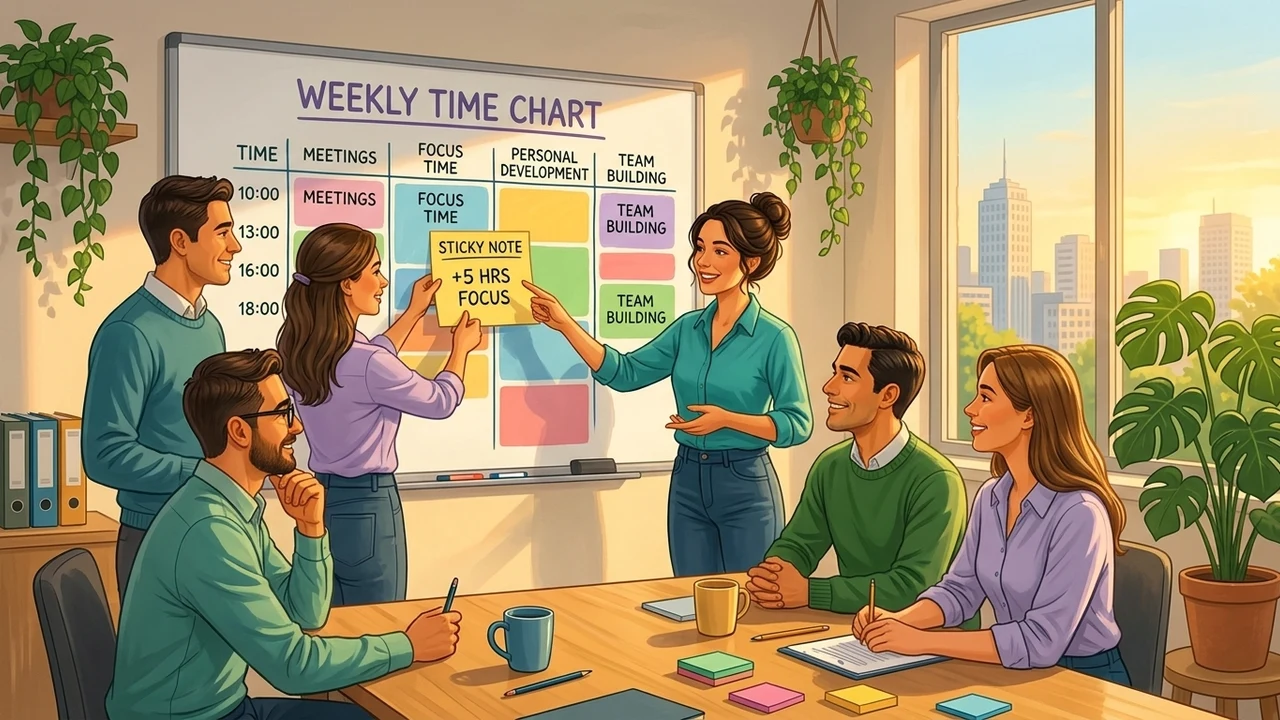
Work-life balance sounds like a concept that costs nothing but good intentions. In practice, it founders on a lack of tools, unclear boundaries, and a work culture that confuses availability with commitment. The workshop provides both: methods and the explicit permission to apply them.
What can a 2- to 3-hour workshop really achieve?
No workshop changes a corporate culture in two hours. What it can do: give employees a framework for reflecting on their own situation and introduce concrete techniques they can apply the very next day. Time management doesn't mean getting everything done faster — it means deciding what actually matters. Setting boundaries isn't a self-protection technique, it's a skill that has to be learned. Truly logging off at the end of the day is a decision that requires permission.
Why should managers be in the same workshop?
A work-life balance workshop for employees falls flat if their manager keeps sending emails at 10 p.m. afterward. The most effective format: mixed groups of team members and management reflecting together and agreeing on what applies within this team. That shared process is the real effect of the workshop. A good complement is the best practice Phone-Free Lunch Break: A Real Break Instead of a Second Screen.
How to put it in place
- 1Select a trainer or coach with a focus on setting boundaries, prioritising and time management, and book a one-day format.
- 2Tailor the content with the trainer to typical strains in the company, such as constant availability or a flood of meetings.
- 3Secure a suitable room and limit the group to a maximum of twelve people so that people can speak openly.
- 4Announce the workshop in an inviting way and specifically address those who feel "it's never enough" – without stigma.
- 5Collect registrations and give participants a small reflection question in advance, for example: where do I lose my time?
- 6Ensure an undisturbed setting: phones away, cover arranged, enough breaks.
- 7Make sure everyone leaves with a concrete personal resolution and a prioritisation method.
- 8At the end, collect together which conditions in the company make boundaries difficult, such as the expectation of evening e-mails.
- 9Ask for satisfaction and perceived benefit straight after the workshop.
- 10After four weeks, follow up on which resolutions have held in daily life and where it is not working.
- 11Pick up the organisational strain factors collected and discuss possible rules with the management, such as meeting-free times.
What you need
- Effort
- half a day
- Cost
- with budget
- Duration
- 1 day
- Setup
- 240 min
- ✓ High relevance
- ✓ Concrete tools
- ✓ Sustainable
Adopt it for your company
One click — and the measure sits ready in your plan. Guided step by step, no lengthy setup.
ÜbernehmenZahlt ein auf
Measure the impact with
Handlungsfeld
Passender Anlass
Passende Best Practices
Nicht sicher, wo ihr anfangen sollt? Selbstcheck →